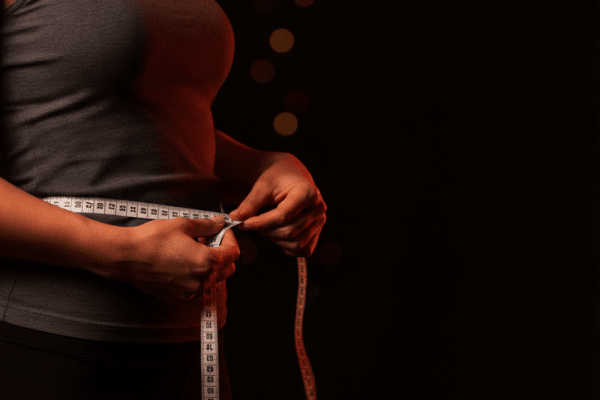

The bathroom scale gives you one number. It can’t tell you whether a change came from fat, muscle, or water. An InBody scan breaks your weight into parts. That’s why we include one in every first visit at RedLight Freedom.
If you’ve been searching for an “InBody scan near me” around Glen Allen, Short Pump, or Richmond, this guide covers what the scan measures, how accurate it is, and how to prep so your numbers mean something. It also shows how we use the scan to measure your progress instead of guessing.
What is an InBody scan?
An InBody scan is a body-composition test done on an InBody analyzer. Our studio uses the InBody 380. You stand barefoot on the platform and hold two handles. The device sends a small, painless electrical signal through your body and measures how much each part resists it. This method is called bioelectrical impedance analysis, or BIA.
Water-rich tissue like muscle conducts the signal easily. Fat resists it more. From those readings, the analyzer estimates what your body is made of.
According to InBody, the 380 uses eight contact points (one under each hand and foot) and three frequencies to measure five body segments separately: each arm, each leg, and your torso. InBody also says its analyzers use your measured impedance rather than relying on age- or gender-based estimates. The test itself takes about 30 seconds. InBody technology · InBody 380 overview
What the scan measures
An InBody 380 result sheet can include:
- Weight. The same number the scale shows, as a starting point.
- Skeletal muscle mass. The muscle you can build and train.
- Body fat mass and percent body fat. How much of your weight is fat, in pounds and as a percentage.
- Total body water. An estimate of the water in your body.
- Lean mass by segment. How muscle is distributed across your arms, legs, and torso.
The full report also lists protein, minerals, fat-free mass, and BMI. InBody 380 overview
When we review a first-visit scan with you, we focus on three numbers most people care about: weight, skeletal muscle, and body-fat percentage.
Why an InBody scan tells you more than the scale or BMI
BMI is a quick screening number, but it has limits. The CDC notes that BMI doesn’t directly measure body fat, and it can’t tell fat from muscle or bone. CDC: About BMI
That matters when you’re making real changes. Say you’re walking more, eating better, and building a steady wellness routine. You could lose fat and keep or gain muscle while the scale barely moves. A body-composition scan helps show that shift, so you don’t give up on a plan that’s working.
Muscle is also worth watching as the years add up. The European consensus on sarcopenia (age-related decline in muscle) describes it as common in older adults and encourages catching changes early. An InBody scan doesn’t diagnose sarcopenia. It does give you a simple way to keep an eye on your skeletal muscle over time. Cruz-Jentoft et al., 2019
How accurate is an InBody scan?
Here’s the honest answer: an InBody scan is a well-studied estimate. It’s useful for tracking trends, and it isn’t a medical diagnostic.
- Consistent. In a 2020 study of 67 healthy adults, three InBody models gave highly repeatable results. McLester et al., 2020
- Tends to read body fat a little lower than a DXA scan. DXA is the X-ray body-composition test often used as a lab reference. In that same study, the InBody devices read body fat slightly lower than DXA and fat-free mass slightly higher. Individual error was small, and the researchers concluded InBody can be used when DXA isn’t available.
- Best for comparing yourself to yourself. A study of adults with obesity found two InBody models were accurate for group averages. Individual readings varied more. Nickerson et al., 2020 European clinical guidelines likewise note that BIA works best in healthy people whose hydration is stable. Kyle et al., 2004
Neither study tested the InBody 380 itself, but they show how InBody-style analyzers behave. The takeaway is simple. Your trend matters more than any single reading, and similar conditions from scan to scan make that trend easier to trust.
How to prep for your scan
Water, food, and activity can nudge a BIA reading. In one study, drinking about 600 ml (roughly 20 oz) shifted body-fat readings within 30 minutes. Forejt et al., 2023 Another found readings kept changing in the two hours after a baseline test, and recommended standardizing hydration and meals before testing. Schierbauer et al., 2023
InBody’s own prep guidance comes down to a few habits: InBody test prep
- Skip a meal right before. InBody suggests waiting about three hours after eating.
- Keep hydration normal. Drink as you usually would, but avoid a big drink right before your scan.
- Hold the workout until after. Exercise, a sauna, or a hot bath beforehand can change your numbers.
- Use the restroom first.
- Remove jewelry and watches, and skip lotion on your hands and feet.
- Keep the timing consistent. Scan at a similar time of day each time so your results compare fairly.
Who should not have an InBody scan
InBody’s user manual says people with implanted electronic medical devices, such as a pacemaker, must not be tested. It also says anyone who is pregnant should talk with their doctor first, and that metal implants may affect results. If any of these apply to you, tell us before your visit. InBody 380 User’s Manual
How we use the InBody 380 at RedLight Freedom
At RedLight Freedom, the InBody scan is part of a bigger plan. Your first visit includes an InBody 380 body-composition scan alongside the rest of the Freedom Method:
- A consultation with a red light specialist.
- A 15-minute full-body session in our Prism or Renu Light Pod.
- A 10-minute session on the vibration plate.
- Personalized recommendations for nutrition, movement, and your next steps.
The scan gives that plan a starting line. Instead of guessing whether your routine is doing anything, you have real numbers to look back on. That’s the idea behind our whole approach: measured, not guessed. See everything included on our What We Offer page.
If your main goal is body composition, our guide to red light therapy and stubborn fat explains what the research says. It also covers how to track progress with realistic expectations.
Frequently asked questions
Does an InBody scan hurt?
No. You won’t feel the signal. You just stand on the platform and hold the handles for about 30 seconds.
Is an InBody scan a medical test?
No. The InBody 380 estimates body composition for wellness tracking. It doesn’t diagnose or treat any condition. Bring any medical questions about weight, muscle, or hydration to your healthcare provider.
How accurate is my InBody result?
It’s a reliable estimate, and it’s most useful for tracking your own trend over time. Research on InBody analyzers shows consistent results, with body-fat readings that run slightly lower than a DXA scan. Prepping the same way each time helps most.
Why did my numbers change from one scan to the next?
Short-term changes in water, food, exercise, or time of day can move a reading. Compare scans taken under similar conditions, and look at the direction over several weeks rather than one day.
Where can I get an InBody scan in Glen Allen?
RedLight Freedom includes an InBody 380 scan in every first visit at our Glen Allen studio, together with your consultation, full-body light session, and vibration plate session.
Get your baseline
The scale tells you what you weigh. An InBody scan tells you what that weight is made of, so you can see your progress clearly. If you’re ready for a routine with real numbers behind it, book your first visit. We’ll scan, walk you through your results, and build a plan around your goals.
Sources
- InBody Co., Ltd. InBody380 result sheet overview. Accessed 2026-09-15.
- InBody Co., Ltd. InBody380 User’s Manual (IM-ENG-P9-B-240111). 2024. Contraindications §6.1; metal implants p. 25. Hosted by InBody Canada, because InBody USA’s copy returns 403. Accessed 2026-09-15.
- InBody USA. InBody technology. Accessed 2026-09-15.
- InBody USA. InBody test: how to prepare. Accessed 2026-09-15.
- Centers for Disease Control and Prevention. About Body Mass Index (BMI). Accessed 2026-09-15.
- McLester CN, Nickerson BS, Kliszczewicz BM, McLester JR. Reliability and agreement of various InBody body composition analyzers as compared to dual-energy X-ray absorptiometry in healthy men and women. J Clin Densitom. 2020. PMID 30472111.
- Nickerson BS, et al. Agreement between 2 segmental bioimpedance devices, BOD POD, and DXA in obese adults. J Clin Densitom. 2020. PMID 31122829.
- Kyle UG, et al. Bioelectrical impedance analysis, part II: utilization in clinical practice. Clin Nutr. 2004. PMID 15556267.
- Forejt M, et al. Changes in segmental impedances and selected body composition parameters assessed by multi-frequency bioimpedance analysis. Int J Med Sci. 2023. PMID 38058961.
- Schierbauer J, et al. Acute fluid intake impacts assessment of body composition via bioelectrical impedance analysis. Metabolites. 2023. PMID 37110132.
- Cruz-Jentoft AJ, et al. Sarcopenia: revised European consensus on definition and diagnosis. Age Ageing. 2019. PMID 30312372.