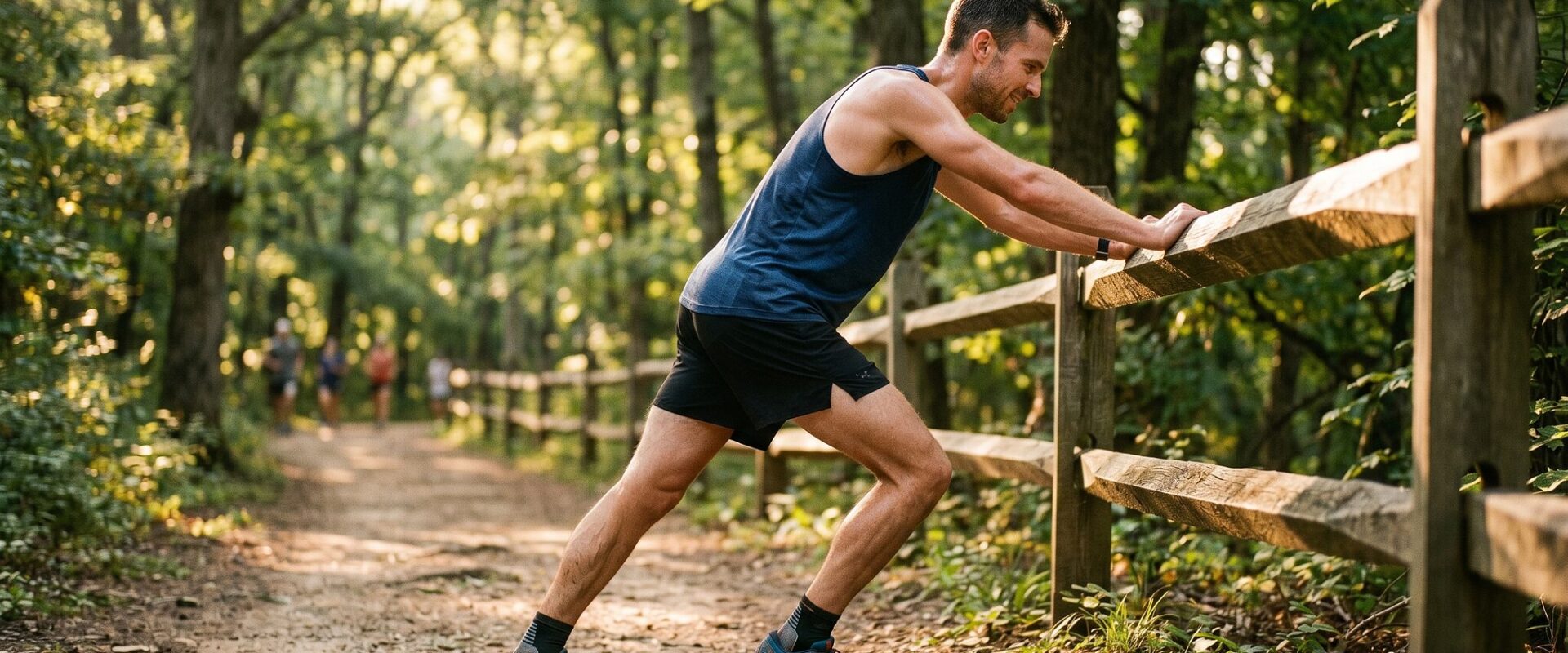
You finished a long, humid run along the James River feeling strong. Then day two arrives, and your quads file a formal complaint every time you take the stairs. If you train through a Virginia summer, you know the drill: stacked mileage, heavy heat, and legs that take longer to bounce back. You’ve probably tried ice baths, foam rollers, compression socks, and that one stretching routine you swear by for a week at a time. Red light therapy for endurance recovery is another tool worth understanding, especially when soreness keeps interrupting your training rhythm. This guide walks through what the research actually says, where the evidence is strong, where it’s still thin, and how a 15-minute full-body session fits into a busy summer training block.
What’s actually happening when your muscles get sore
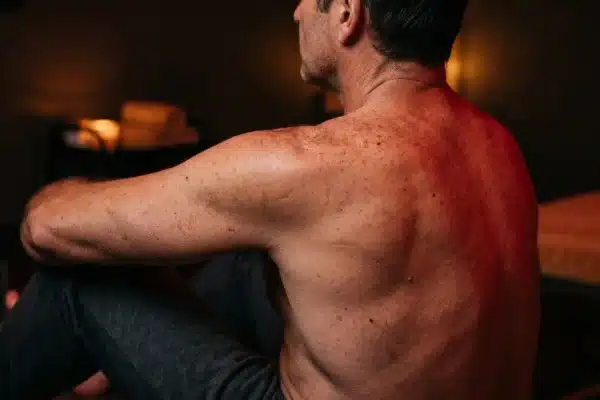
That deep ache one to three days after a hard effort has a name: delayed onset muscle soreness, or DOMS. According to the Cleveland Clinic, DOMS is muscle pain that begins one to three days after intense exercise, caused by microscopic tears in muscle fibers, especially during eccentric loading like running downhill or the lowering phase of a lift (Cleveland Clinic). It’s part of your body’s normal repair and adaptation process, and it’s generally not harmful.
That’s worth repeating: soreness is usually a sign your muscles are rebuilding, not breaking. The goal of any recovery tool isn’t to eliminate the adaptation, just to make the day-after feel less punishing so you can keep training. For endurance athletes piling up summer miles, that day-after feeling is often the difference between hitting your next session and skipping it.
What the research shows about red light therapy for endurance recovery
Photobiomodulation (PBM), the formal name for red light therapy, has been studied for exercise performance and recovery for over a decade. Here’s an honest read of what the science says.
Pre-exercise light may give a small performance edge. A systematic review with meta-analysis of 13 randomized controlled trials found that phototherapy applied before exercise increased time-to-exhaustion (by about 4.12 seconds) and total repetitions (by about 5.47) compared to placebo, with red and near-infrared light used pre-exercise showing the most consistent results (Leal-Junior et al., 2015). The authors were clear that the effects, while real, were modest.
A single dose can extend time-to-exhaustion in cyclists. In a study of 16 competitive male cyclists, a single pre-exercise dose increased time-to-exhaustion by roughly 10 to 12 percent versus placebo, with faster VO2 kinetics (Lanferdini et al., 2023). One honest caveat from that same study: the effect faded by the third successive cycling bout, so this isn’t an all-day booster.
Soreness reduction is the most relevant claim for endurance training. In a study of 30 untrained men running a structured program, red plus near-infrared light (660 and 850nm, the same wavelength family the Prism Light Pod uses) produced a moderate effect size (0.82) for reduced muscle soreness at week three (Peserico et al., 2019). Important context: there were no statistically significant differences between the light and placebo groups, so the finding is directional, not proof.
Here’s the honest anchor. The largest review to date, covering 39 randomized controlled trials and 861 participants, did find some effect favoring phototherapy for muscular performance and fatigue, but the authors graded the overall evidence as very low to moderate quality (Vanin et al., 2018). In plain terms: the signal is encouraging and pointing in a helpful direction, but it isn’t airtight. Anyone promising guaranteed gains is overselling it. We’d rather you know that going in.
The wavelengths that matter
Not all light does the same thing, and the specifics matter for recovery.
The Prism Light Pod uses 630nm and 660nm red light plus 850nm near-infrared light. These wavelengths aren’t arbitrary. They closely match the absorption peaks of cytochrome c oxidase, an enzyme in your cells’ mitochondria. When that enzyme absorbs red and near-infrared light, the result is more efficient production of ATP, your cells’ main energy currency. More cellular energy is the proposed mechanism behind faster recovery and reduced fatigue.
Near-infrared light (850nm) penetrates deeper into tissue than visible red, which is why a recovery device aimed at muscle uses both. The Prism Light Pod packs 17,000+ medical-grade LEDs into a 360-degree full-body bed delivering roughly 100 mW/cm², so your legs, back, and shoulders all get covered in one session rather than treating one spot at a time. It’s an FDA-cleared Class II medical device, which is a meaningful distinction from the small consumer panels you might have seen online.
Endurance recovery is whole-body: the RedLight Freedom method
Here’s where we draw a firm line between what studies do and what we recommend.
Many of the studies above used frequent dosing, three to five sessions per week or even daily, often in short research windows. That’s a research protocol, designed to isolate effects in a controlled setting. It is not our protocol.
At RedLight Freedom, we recommend up to two sessions per week. That’s it. The reason is twofold. First, the Prism Light Pod is a medical-grade device operating at a much higher intensity than a handheld panel. Second, photobiomodulation follows a biphasic dose-response, which is a fancy way of saying more is not better. Past a certain point, piling on extra sessions doesn’t add benefit and can actually work against you. So when you read about a study running daily sessions, attribute that cadence to the study, not to us. Our up-to-twice-weekly rhythm is built around the Pod’s intensity and how your body actually responds.
For a summer training block, two sessions a week slots in cleanly: one after your hardest effort, one as a midweek reset. We program the Pod’s Sports Recovery setting for athletes, which is tuned for exactly this use.
A quick word on the summer angle. We won’t pretend there’s a study proving red light offsets heat load from a humid James River long run, because there isn’t one. Think of it instead as a comfortable, low-effort way to give your legs some attention during your heaviest, most heat-stacked weeks. Try a session after a brutal block and see how your legs feel. That’s the honest framing, and it’s the one our clients appreciate.
What a session looks like at RedLight Freedom
The experience is refreshingly simple. You lie down inside the full-body Pod, put on the provided eye protection, and relax for 15 minutes. There’s no UV, no heat, and nothing to do but rest. Most clients find it genuinely restorative, a rare 15 minutes of stillness in a packed training week. Many of our clients tell us the session itself becomes a mental reset as much as a physical one.
Fitting it around training is easy. A quarter hour, lying down, is far simpler to schedule than an ice bath or spot-treating one sore muscle at a time. Pop in after a workout on your way home.
Your first session is offered at our introductory rate, which is a low-commitment way to feel it for yourself before your next big training week. Returning pricing is customized at your visit.
We’re located at 11391 Nuckols Rd, Suite C, Glen Allen, VA 23059VA, easy to reach from Petersburg, Hopewell, Chester, and Fort Lee. We’re open Tuesday through Saturday, 9 AM to 5 PM. Call us at (804) 689-2200 or book online.
One safety note, because it matters: you’ll need to lie down and get up unassisted. If you’re pregnant, breastfeeding, managing active cancer, or have a seizure disorder, please consult your provider before booking. Red light therapy is a wellness service, not a substitute for medical care.
Frequently asked questions
Will red light therapy make me faster?
Honestly, we won’t promise that. The research on performance shows modest, directional effects, mostly from light applied before exercise, and the better-quality reviews grade the overall evidence as low to moderate (Vanin et al., 2018). The more relevant benefit for most endurance athletes is the potential to feel less wrecked the day after a hard effort, so you can train consistently. Consistency, not a single magic session, is what makes you faster over a season.
How often should I use the Pod during heavy training?
Up to two sessions per week, no more. The Prism Light Pod is a medical-grade device, and red light follows a biphasic dose-response where more isn’t better. You might see studies running daily sessions, but that’s a research setting. For our Pod, twice weekly is the sweet spot: pair one with your hardest workout and one as a midweek reset.
Can I come in right after a long run?
Yes, and many athletes prefer it that way. There’s no heat and no UV, so it won’t add to the thermal load of a hot summer run. You just lie down for 15 minutes and let your legs rest. As long as you can get on and off the Pod unassisted, post-run timing works well.
The takeaway
Red light therapy isn’t a miracle, and we’d never sell it as one. What the evidence supports is reasonable: it may help reduce muscle soreness, and pre-exercise dosing can offer a small, modest performance edge, though the highest-quality reviews still rate the overall evidence as low to moderate. For an endurance athlete grinding through a hot Tri-Cities summer, a 15-minute, full-body, no-heat session is an easy, restorative tool to slot into your toughest training weeks. Try it before your next big block and see how your legs respond. Your first session is offered at our introductory rate. Book online or call (804) 689-2200, and let your summer miles feel a little kinder on the way back.
Sources
- Cleveland Clinic. Delayed Onset Muscle Soreness (DOMS). https://my.clevelandclinic.org/health/diseases/delayed-onset-muscle-soreness
- Lanferdini FJ, et al. Effects of Photobiomodulation Therapy on Performance in Successive Time-to-Exhaustion Cycling Tests. J Funct Morphol Kinesiol. 2023;8(4):144. https://pubmed.ncbi.nlm.nih.gov/37873903/
- Leal-Junior ECP, et al. Effect of phototherapy (low-level laser therapy and light-emitting diode therapy) on exercise performance and markers of exercise recovery: a systematic review with meta-analysis. Lasers Med Sci. 2015;30(2):925-939. https://pubmed.ncbi.nlm.nih.gov/24249354/
- Vanin AA, et al. Photobiomodulation therapy for the improvement of muscular performance and reduction of muscular fatigue associated with exercise in healthy people: a systematic review and meta-analysis. Lasers Med Sci. 2018;33(1):181-214. https://pubmed.ncbi.nlm.nih.gov/29090398/
- Peserico CS, et al. Effects of Endurance Running Training Associated With Photobiomodulation on 5-Km Performance and Muscle Soreness: A Randomized Placebo-Controlled Trial. Front Physiol. 2019;10:211. https://pubmed.ncbi.nlm.nih.gov/30890962/