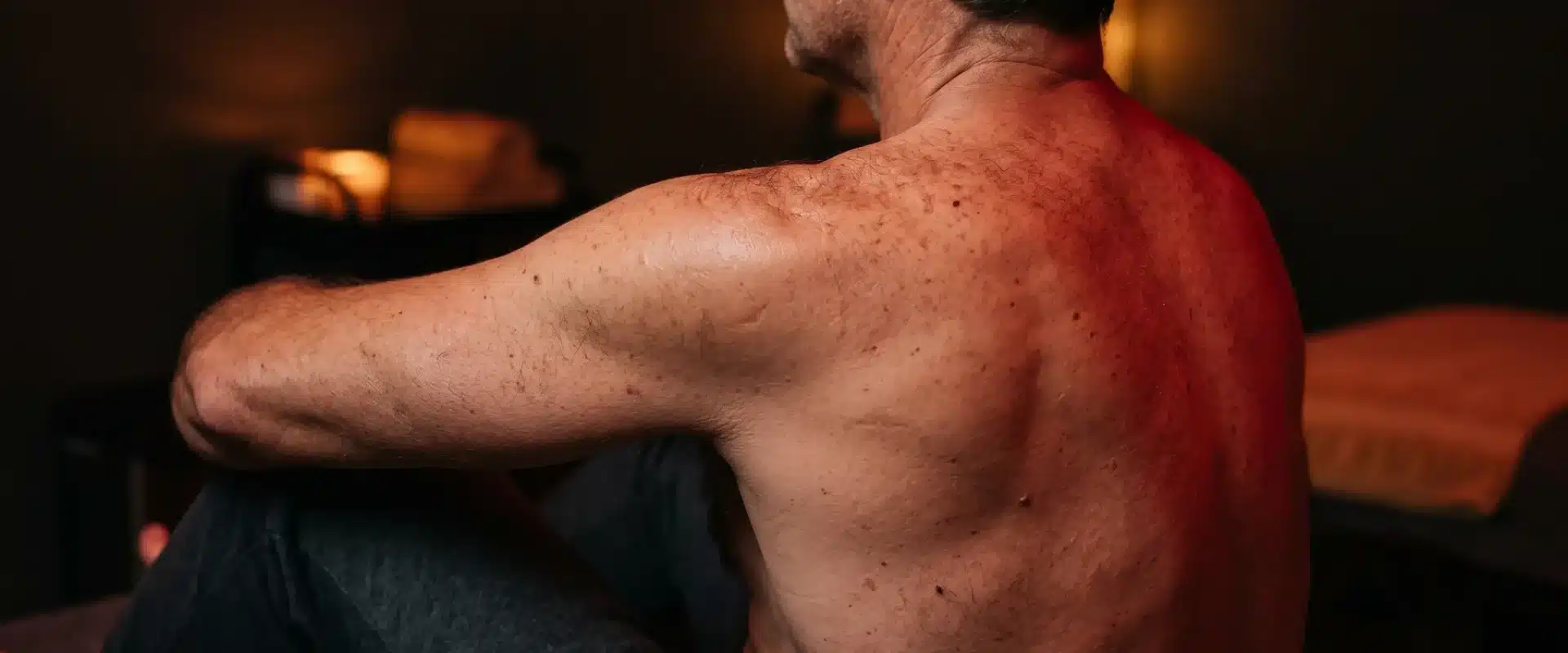
If your knees, back, or shoulders have been keeping score since basic, you already know the drill: ibuprofen, ice, push through, repeat. The body doesn’t forget years of PT, ruck marches, parachute landings, and lifting things no civilian job will ever ask you to lift. By the time you’re a decade past your service, the record is in your joints — and it doesn’t go away on its own.
This blog is going up Memorial Day weekend — a day for remembrance, not promotion. We’re not trying to make this about the day. We just want to put one piece of practical, evidence-grounded information in front of veterans in the Tri-Cities area who’ve been working around chronic pain for a while and haven’t seen red light therapy explained without the hype.
Here’s what the research actually says about red light therapy for veterans dealing with chronic back, knee, and shoulder issues, sleep disturbance, and post-training recovery — and where the whole-body Prism Light Pod at our Colonial Heights studio fits in.
What’s actually going on in service-era pain
Musculoskeletal disorders are the single largest category of service-connected disability in the VA system. Per the VA’s most recent annual benefits report, roughly a quarter of all service-connected disabilities are musculoskeletal — lumbosacral strain, limited knee flexion, and limited ankle range of motion sit near the top of the list (VA Annual Benefits Report, 2023).
Two-thirds of US veterans report chronic pain in the past three months, and roughly 9% report severe chronic pain — meaningfully higher than the non-veteran adult population (Nahin, 2017). A separate review in Military Medicine documented how repetitive load-bearing — ruck marches in the 35–100 pound range, sustained PT, repeated jumping and lifting — drives early-onset osteoarthritis and patellofemoral syndrome in service members (Reynolds et al., 2016).
Sleep is the other quiet one. Approximately 57% of Iraq and Afghanistan-era veterans report clinically significant insomnia (Alexander et al., 2016) — about double the civilian rate. Even setting aside the cases tied to other conditions, baseline sleep disturbance in veteran populations runs well above the general adult baseline.
None of that goes away with willpower. The tissue under chronic mechanical load runs a chronic energy deficit at the cellular level. Repair gets slower. Inflammation lingers. The same joints and muscles that absorbed years of use need ongoing support to keep up with the maintenance work the body would otherwise do quietly.
What the research shows about red light therapy and chronic pain, joints, sleep, and recovery
Photobiomodulation (the clinical name for red and near-infrared light therapy) has a real body of evidence in exactly the areas service-era wear and tear tends to live.
Chronic low back pain. A 2015 meta-analysis in Pain Research and Treatment pooled the randomized trials on low-level laser therapy for chronic LBP and found that LLLT meaningfully reduced pain compared with placebo, with effects that persisted at follow-up (Huang et al., 2015). A separate 2016 meta-analysis in Acupuncture in Medicine covering non-specific chronic LBP found a pooled mean difference of roughly 2 points on the visual analog pain scale versus sham, with moderate evidence quality (Glazov et al., 2016).
Knee and joint pain. A 2019 BMJ Open meta-analysis of photobiomodulation for knee osteoarthritis pooled the RCT evidence and found significant pain reduction and functional improvement, particularly when optimal dosing was used (Stausholm et al., 2019). The mechanism — increased ATP availability for cartilage and surrounding soft tissue — fits the kind of wear-and-tear arthritis that shows up in joints with high lifetime mechanical load.
Post-training and post-exercise recovery. A 2015 meta-analysis of photobiomodulation for exercise performance and recovery found that PBM applied pre-exercise reduced post-exercise creatine kinase (a muscle damage marker) and improved recovery markers across the studies pooled (Leal-Junior et al., 2015). A 2016 review by Ferraresi and colleagues confirmed that PBM in human muscle tissue offers a measurable advantage for sports performance and recovery, particularly when applied around training (Ferraresi et al., 2016).
Sleep quality. Work in athletic and general populations has shown that red light exposure can improve sleep quality scores and increase serum melatonin (Zhao et al., 2012). Notably, red light at the wavelengths used in therapy does not suppress melatonin the way short-wavelength blue light does — meaning an evening session is sleep-friendly rather than disruptive.
Honest caveat: most studies in this body of literature use targeted panels and lasers on specific body regions, with sample sizes ranging from small to moderate. The direction of the evidence is consistent and the mechanism is well understood, but it’s still a field where larger trials would help. We frame the results conservatively because the evidence supports a real but realistic expectation, not a hype claim.
The wavelengths that matter — and why
When researchers run the trials we just cited, they aren’t testing a particular brand. They’re testing a wavelength range — the specific bands of light that mitochondria actually absorb. The studies converge on two windows:
- 620–680 nm in the red spectrum for surface and mid-tissue effects
- 800–880 nm in the near-infrared range for deeper penetration into muscle, joints, and connective tissue
Those numbers aren’t arbitrary. They match the absorption peaks of cytochrome c oxidase — an enzyme deep in the mitochondrial respiratory chain. When that enzyme absorbs the right light, it accelerates ATP production. In plain English: tissues that have been working under chronic load for years get more cellular fuel to do the repair and maintenance work they’re already supposed to be doing.
The Prism Light Pod at RedLight Freedom delivers 630 nm and 660 nm red plus 850 nm near-infrared across more than 17,000 medical-grade LEDs. Those are the exact wavelengths the published research has used — applied to your entire body, head to feet, in a single 15-minute session. Your lumbar spine, your knees, your shoulders, your traps, your hips — every joint and muscle group that has logged the miles gets exposed at once.
Service-era wear is whole-body — the RedLight Freedom approach
Most of the chronic pain research uses panels or lasers targeted at one area at a time. That works — and it informs everything we do — but if you’re carrying load in the lumbar AND the knees AND the shoulders (most veterans we see are), a panel approach forces you to pick. The Prism Pod flips that. One 15-minute session covers all of it simultaneously.
Our protocol: up to 2 sessions per week. Not daily, not 5×/week. The Prism Light Pod is a medical-grade, FDA-cleared Class II device, and more isn’t automatically better — photobiomodulation follows a biphasic dose-response curve, meaning the right dose helps and too much reduces the effect. Twice-weekly sessions over 4–8 weeks is where most clients dealing with chronic mechanical load start noticing changes: morning stiffness eases first, range of motion returns next, sleep usually settles in across the second month.
Two sessions a week sounds conservative compared to studies that ran 3–5 sessions weekly in clinical settings. Here’s why we take that approach: the Pod’s medical-grade output delivers significantly more energy per session than the smaller consumer panels used in much of the research. Twice weekly with our equipment is calibrated to where the curve helps, not where it tips into diminishing returns.
A factual note on HSA and FSA
Red light therapy sessions can qualify as an HSA- or FSA-eligible expense when accompanied by a Letter of Medical Necessity from a licensed provider (governed by IRS Publication 502). Many post-service civilian employment plans include HSA or FSA balances. Eligibility is plan-dependent — we won’t promise it for every situation, but it’s worth asking your plan administrator before you write off the cost.
What red light therapy is not
To stay honest with you:
- Not a treatment for PTSD or any mental health condition. That’s a separate evidence base, separate professional care, and not something this blog is in the lane to discuss.
- Not a treatment for TBI. There’s emerging research in transcranial photobiomodulation in different contexts, but it’s preliminary and outside what the Prism Pod is designed for.
- Not a replacement for VA care, prescribed medications, physical therapy, or any care you’re already receiving. Use this alongside the rest of your plan, not instead of it.
- Not for pregnancy. Still a precaution. If that applies to a military spouse reading this, wait.
If chronic back, knee, or shoulder pain — or sleep that doesn’t reset — is what you’re working on, and you’d like a non-pharmaceutical option to add to whatever you’re already doing, red light therapy is worth knowing about.
What a session looks like at RedLight Freedom
You’ll come into our Colonial Heights studio — quiet, private, no rush. You’ll wear eye protection. You’ll lie down inside the Prism Light Pod, which looks like a sleek clamshell bed lined with 17,000+ LEDs. The session runs 15 minutes. The light covers you head to toe. No UV, no harsh heat, no prep.
Most clients describe sessions as warm, quiet, and unexpectedly restorative. Some fall asleep.
Your first session is $99 (regularly $299). That includes the full 15-minute Pod session, a relaxed intake conversation about what you’re working on, and a clear plan for how often to come back. No upsell, no script.
We’re at 2903 Boulevard, Suite B in Colonial Heights — about 25 minutes from the Fort Lee gate and within easy reach of Petersburg, Hopewell, and Chester. Open Tuesday through Saturday, 9 AM to 5 PM. Book at redlightfreedom.com or call (804) 689-2200.
Frequently asked questions
Can I use red light therapy alongside the medications the VA has me on?
In general, yes. Red light therapy is non-pharmaceutical and doesn’t interact with most medications. A small note: some medications increase photosensitivity (certain antibiotics, retinoids, St. John’s wort, some SSRIs). Bring your med list at your first visit and we’ll walk through it. Always loop your VA care team in on any new wellness practice you’re adding.
Will red light therapy affect my disability rating?
No. Red light therapy is a wellness practice, not a clinical treatment, and it doesn’t reduce or affect service-connected disability ratings. You’re not “cured” because you used it. You’re using a tool that may help with comfort and recovery alongside your existing care.
How long before I notice a difference?
Most clients describe feeling looser and warmer after the first session. Real changes in chronic stiffness and pain usually start showing up within the first 3–4 weeks of consistent twice-weekly sessions. Sleep improvements often follow on a similar timeline. Most clients give the protocol 4–8 weeks before judging it. The veterans who stay consistent through that window almost always tell us it was worth it.
The takeaway
Service leaves a record in your body. That’s not a complaint — it’s just the math of what the job asks of people who do it. The right approach to chronic wear and tear is one that respects your existing VA care, doesn’t promise miracles, and gives your body the kind of cellular support that helps tissue that’s been working under load for years.
Red light therapy at the studied wavelengths has real research behind it for chronic back and joint pain, post-training recovery, and sleep quality. Paired with whatever else you’re already doing — PT, medications, movement, sleep hygiene — twice-weekly Pod sessions can become a meaningful drug-free part of how you maintain the body you have to live in.
If that’s worth a closer look, your first session at RedLight Freedom is $99. Call (804) 689-2200 or book online. We’ll take it from there.
Related reading
- Home Panel vs. Professional Pod
- How We Read the Red Light Research
- Your First Red Light Session: What to Expect in 15 Minutes
- Red Light Therapy for Inflammation
- Red Light Therapy for Sleep & Circadian Rhythm
- Red Light Therapy for Workout Recovery
Sources
- US Department of Veterans Affairs. Annual Benefits Report, Fiscal Year 2023. https://www.benefits.va.gov/REPORTS/abr/
- Nahin RL. Severe Pain in Veterans: The Effect of Age and Sex, and Comparisons With the General Population. Journal of Pain. 2017. https://pubmed.ncbi.nlm.nih.gov/27664757/
- Reynolds K, Cosio-Lima L, Bovill M, et al. A Review of the Epidemiology of Knee, Back, and Shoulder Injuries in the Military. Military Medicine. 2016. https://pubmed.ncbi.nlm.nih.gov/26741475/
- Alexander M, Ray MA, Hébert JR, et al. The National Veteran Sleep Disorder Study: Descriptive Epidemiology and Secular Trends. Sleep. 2016. https://pubmed.ncbi.nlm.nih.gov/26715228/
- Huang Z, Ma J, Chen J, et al. The effectiveness of low-level laser therapy for nonspecific chronic low back pain: a systematic review and meta-analysis. Pain Research and Treatment. 2015. https://pubmed.ncbi.nlm.nih.gov/26568892/
- Glazov G, Yelland M, Emery J. Low-level laser therapy for chronic non-specific low back pain: a meta-analysis of randomised controlled trials. Acupuncture in Medicine. 2016. https://pubmed.ncbi.nlm.nih.gov/26733331/
- Stausholm MB, Naterstad IF, Joensen J, et al. Efficacy of low-level laser therapy on pain and disability in knee osteoarthritis: systematic review and meta-analysis of randomised placebo-controlled trials. BMJ Open. 2019. https://pubmed.ncbi.nlm.nih.gov/31662383/
- Leal-Junior ECP, Vanin AA, Miranda EF, et al. Effect of phototherapy on exercise performance and markers of exercise recovery: a systematic review with meta-analysis. Lasers in Medical Science. 2015. https://pubmed.ncbi.nlm.nih.gov/25761548/
- Ferraresi C, Huang YY, Hamblin MR. Photobiomodulation in human muscle tissue: an advantage in sports performance? Photomedicine and Laser Surgery. 2016. https://pubmed.ncbi.nlm.nih.gov/26891369/
- Zhao J, Tian Y, Nie J, Xu J, Liu D. Red light and the sleep quality and endurance performance of Chinese female basketball players. Journal of Athletic Training. 2012. https://pubmed.ncbi.nlm.nih.gov/23068591/
- Hamblin MR. Mechanisms and applications of the anti-inflammatory effects of photobiomodulation. AIMS Biophysics. 2017. https://pubmed.ncbi.nlm.nih.gov/28748217/