The question we hear every week
“Should I buy a panel for home or just come to your studio?”
It’s a fair question — and the marketing from both sides makes it harder to answer.
Panel manufacturers emphasize irradiance numbers. Pod companies counter with LED counts.
Neither gives you the full picture.
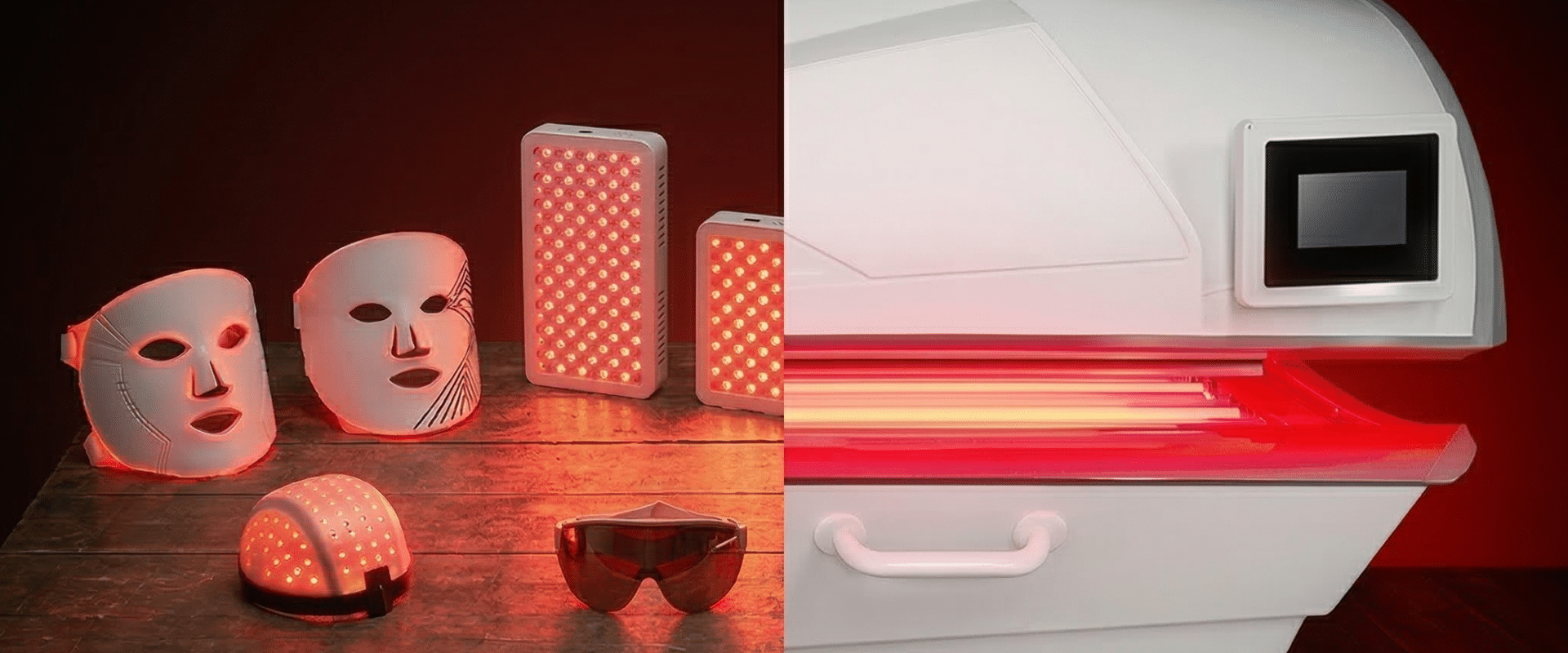
We run a professional studio with a Prism Light Pod —
so yes, we have a financial interest. But we also tell every client the same thing:
keep using your home panel between visits. The two aren’t enemies.
They fill different roles.
What this article does is show you the real math, the real dosing science, and
the real tradeoffs — so you can decide what makes sense for your goals and budget.
The hardware, side by side
The three most popular home panels sit in the $1,200–$1,700 range. Here’s
how they compare to the Prism Light Pod on specs that actually matter:
| Spec | Joovv Solo 3.0 | MitoPRO 1500X | PlatinumLED 900 | Prism Light Pod |
|---|---|---|---|---|
| Price | $1,699 | $1,249 | $1,299 | $299/session† |
| LEDs | 150 | 600 chips | 300 | ~17,000 |
| Wavelengths | 2 (660, 850) | 6 (590–850) | 7 (480–1060) | 3 (630, 660, 850) |
| Coverage area | ~2,032 cm² | ~2,774 cm² | ~2,787 cm² | ~14,000 cm² |
| Body sides treated | Front only | Front only | Front only | 360° simultaneous |
| Irradiance (independent) | ~74 mW/cm² | ~87 mW/cm² | ~90 mW/cm² | Up to 100 mW/cm²‡ |
| FDA status | IEC 60601 | ETL certified | FDA Class II | FDA-cleared Class II |
† First-time visit: $79 (includes consultation). Standard: $299/session. Memberships available.
‡ Manufacturer-stated maximum at skin contact. Effective irradiance varies with LED-to-skin distance.
A note on home panel irradiance claims: All three home panel brands
advertise irradiance measured with consumer-grade solar meters, which consistently
overstate output by 40–55% compared to spectrometer readings
(Light Therapy Insiders / Alex Fergus testing). The independent figures above reflect
real-world output — substantially lower than what you’ll see on the box.
The energy math — showing our work
Total energy delivery is measured in joules. The formula:
Total Joules = (mW/cm²) × (seconds) × (coverage cm²) ÷ 1,000
| Metric | Joovv Solo (front, 10 min) | Joovv Solo (front + back, 20 min) | Prism Light Pod (360°, 15 min) |
|---|---|---|---|
| Energy density (J/cm²) | 44.4 | 44.4 | ~90 |
| Body area treated (cm²) | ~2,032 | ~4,064 | ~14,000 |
| Total energy (kJ) | ~90 | ~180 | ~1,260 |
| Energy vs. pod | 14× less | 7× less | — |
Why coverage area is the deciding factor: Even at conservative
irradiance estimates, the pod delivers roughly 5–10× the total
energy of a single home panel. The dominant factor isn’t power per
LED — it’s the fact that the pod treats ~7× more body
surface simultaneously in a single 15-minute session.
The energy math favors the pod — and the peer-reviewed dosing science explains
why professional guidance matters as much as raw joules.
Why “more joules” doesn’t mean “better results”
This is the part most red light therapy marketing skips entirely. The scientific
literature describes a biphasic dose-response curve — meaning
there’s a therapeutic window where the dose is right, and going above or below
that window reduces effectiveness.
Think of it like watering a plant. Too little and it wilts. The right amount and it
thrives. Too much and you drown the roots. Light therapy works the same way at the
cellular level.
The Biphasic Dose-Response Curve
Both under-treatment and over-treatment reduce effectiveness — established by three landmark studies
Stimulation Zone
At low-to-moderate doses (roughly 1–10 J/cm²), photon absorption increases ATP production and generates a brief, beneficial burst of reactive oxygen species. Cells are energized, repair mechanisms are activated, and inflammation begins to resolve.
Optimal Window
Peak therapeutic effect. Huang et al. found ATP production in cortical neurons peaked at 3 J/cm². For superficial tissues (skin, tendons), the window extends up to 50 J/cm². Tissues with high mitochondrial density (muscle, brain, nerve) require lower doses — and are more sensitive to overdosing.
Inhibition Zone
Excessive doses trigger cytotoxicity. Reactive oxygen species overwhelm the cell’s defenses, mitochondrial membrane potential collapses, and the very processes you’re trying to stimulate begin to reverse. More light becomes counterproductive.
Five Things That Matter More Than Raw Power
The energy gap is real, but it’s not the whole story. These factors explain why clients who own home panels still book studio sessions.
360° Coverage
A single panel illuminates only the front of your body. Full coverage requires repositioning (front → back → sides), doubling session time to 20–40+ minutes. The pod treats anterior, posterior, and lateral surfaces simultaneously in 15 minutes.
Distance Consistency
Light intensity follows the inverse-square law: standing 12” from a panel instead of 6” delivers roughly one-quarter the irradiance. The pod fixes LED-to-skin distance by design (½”–3”). No guessing, no drift.
Session Automation
One button, 15 minutes, auto-shutoff. The three biggest variables in home panel use — timing, distance, and coverage gaps — are eliminated by design. Zein et al. (2018) noted that failed PBM studies often traced back to inconsistent parameters.
LED Maintenance
LEDs degrade over time — cheaper units can lose 10–15% output annually. The decline is gradual and invisible without specialized equipment that virtually no consumer owns. Professional hardware is rated at 100,000 hours with warranty-backed performance.
Protocol Guidance
Our team assesses individual goals, tracks progress, and selects from six pod presets optimized for different conditions. A home panel offers red, NIR, or a 50/50 mix — a much blunter instrument. We also screen for contraindications that home users may overlook.
Important: Red light therapy is not intended to diagnose, treat, cure, or prevent any disease. Results vary by individual. The Prism Light Pod is an FDA-cleared Class II Medical Device cleared for general wellness. Consult your healthcare provider before beginning any new wellness regimen. Energy calculations in this article use manufacturer-stated and independently-measured figures where available and should be considered directional estimates, not precise engineering data.
Sources cited in this article
For more on how we evaluate the quality of these studies, read our
evidence evaluation framework.
Huang, Chen, Carroll & Hamblin (2009) — Biphasic Dose Response in Low Level Light Therapy, Dose-Response
Huang, Sharma, Carroll & Hamblin (2011) — Biphasic Dose Response in LLLT — An Update, Dose-Response
Zein, Selting & Hamblin (2018) — Review of Light Parameters and PBM Efficacy, Journal of Biomedical Optics (270+ citations)
Navarro-Ledesma et al. (2024) — Whole-Body PBM for Pain: Triple-Blinded RCT, Frontiers in Neuroscience
- Independent panel irradiance testing: Light Therapy Insiders / Alex Fergus (spectrometer-based measurements)