
53 million reasons this matters
About 53.2 million American adults — roughly one in five —
live with some form of diagnosed arthritis. By 2040, that number is projected to hit
78 million. The annual economic burden already exceeds $300 billion in medical costs
and lost earnings. If you’re reading this, odds are good that you or someone close to you deals
with joint pain on a daily basis. And if you’ve started looking into
red light therapy as a potential option, you deserve
more than marketing slogans. You deserve to know what the research actually
says — and where it falls short. Here’s a quick primer on the three conditions this article covers:
- Osteoarthritis (OA) — the most common form, affecting
32.5 million U.S. adults. Cartilage wears down over time,
eventually allowing bone-on-bone contact. Hands, knees, hips, and spine are
hit hardest. - Rheumatoid arthritis (RA) — an autoimmune condition where
the immune system attacks the synovium (joint lining). Affects about
1.3 million adults, with women 2–3 times more likely
to develop it. - Degenerative disc disease (DDD) — not technically a disease.
Spinal discs lose water content and thin out over time. Around 90% of cases occur
in the lumbar spine.
What the research actually shows
We reviewed four major analyses — spanning 58 randomized controlled
trials and over 2,900 patients total — to understand what
photobiomodulation (PBM) can and cannot do for joint-related conditions. (For more on
how we evaluate research quality,
see our methodology article.)
Knee osteoarthritis
A 2024 systematic review and meta-analysis in Physical Therapy (Oliveira
et al., 10 RCTs, 542 participants) found that PBM significantly reduced
pain at rest compared to placebo, with a moderate effect size
(SMD −0.7). A companion network meta-analysis (13 studies, 673 participants)
found that 904–905 nm was the most effective wavelength.
Key finding: PBM reduced knee OA pain with a moderate effect size
(SMD −0.7). The researchers note this is a growing field with more trials
underway to further confirm these promising results.
Rheumatoid arthritis
Earlier research showed strong results: an established meta-analysis (Brosseau
et al., 2000) found LLLT reduced pain by 70% relative to placebo,
cut morning stiffness by 27.5 minutes, and increased hand
flexibility by 1.3 cm. More recent reviews continue to explore optimal
dosing, with the most commonly studied wavelengths for RA being infrared
(780–860 nm), with 830 nm appearing most frequently. What this tells us: The wavelengths used in professional
red light therapy align with the parameters that showed the strongest RA
results — and our clients with RA consistently report reduced morning
stiffness and improved hand mobility.
Chronic low back pain
This is where the evidence is strongest. A 2016 meta-analysis in Acupuncture in
Medicine (Glazov et al., 15 RCTs, 1,039 participants) found a significant pain
reduction and patients were 2.16 times more likely to improve with
LLLT compared to control.
Strongest evidence reviewed: Moderate GRADE quality — the
highest of any analysis we examined. But benefits only appeared at doses of
3 Joules per point or higher. Lower doses showed nothing. Dose matters.
Acute low back pain with radiculopathy
A large 2010 RCT (Konstantinovic et al., 546 patients) compared
NSAID plus active LLLT against NSAID alone and NSAID plus placebo LLLT.
The active LLLT group was significantly superior across all
outcomes (p < 0.0005) — pain, range of motion, disability,
and quality of life. The protocol used 904 nm pulsed laser, 15 sessions over 3 weeks.
Important context: This is a large, well-powered trial, but it’s
single-center with no long-term follow-up. The acute nature of the condition limits
generalization to chronic degenerative conditions.
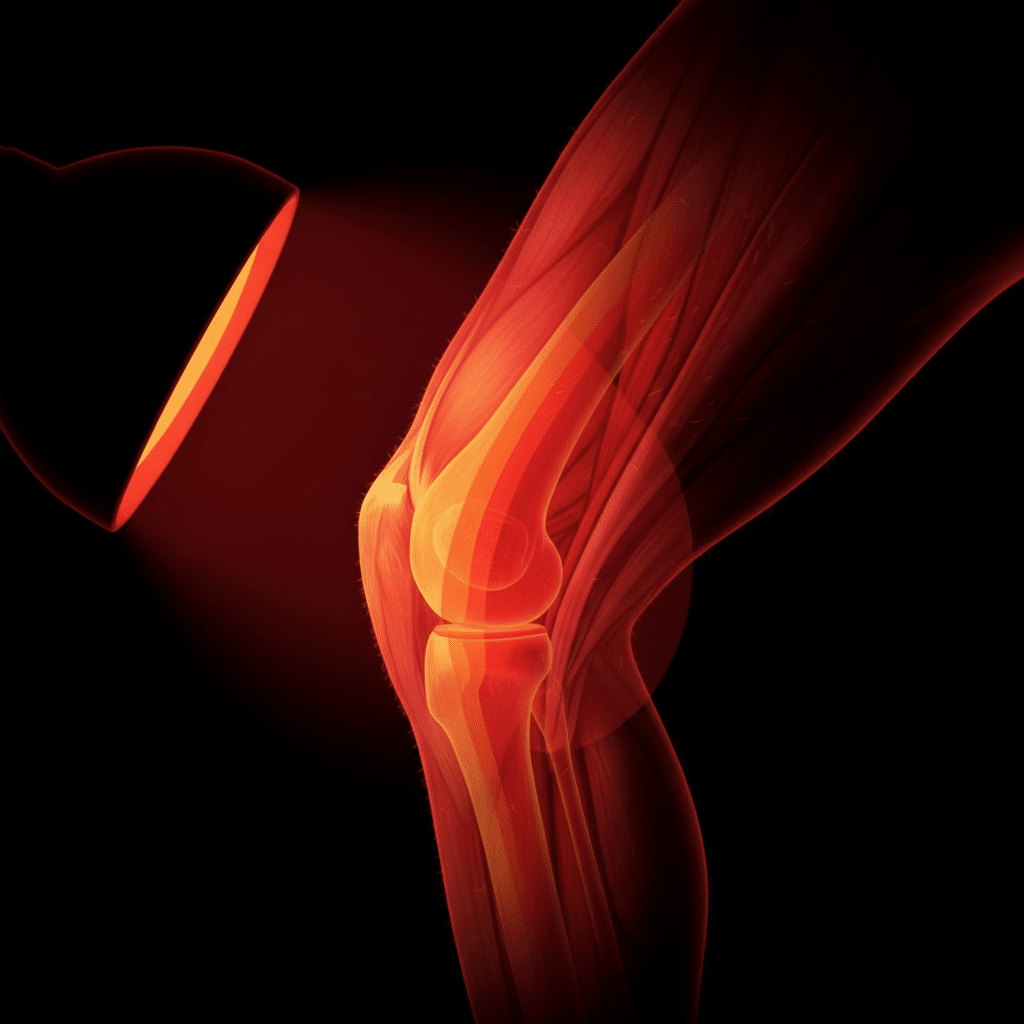
How deep does the light actually go?
Light between 600 and 1,000 nm falls within the “optical
window” — the range where tissue absorption is most
effective. Here’s a practical breakdown of what each wavelength
range delivers:
| Property | 630 nm (Red) | 850 nm (NIR) |
|---|---|---|
| Tissue reach (LEDs) | Skin, surface tissue | Deeper tissue, joints, muscles |
| Small joints (fingers, wrists) | Surface support | Direct tissue access |
| Larger joints (knees, hips) | Indirect support via circulation | Direct + indirect pathways |
| Primary benefit pathway | Circulation, immune cell activation | Cellular energy + circulation combined |
Near-infrared (850 nm) wavelengths penetrate deeper into the body, reaching
muscles and joint tissue. For larger joints like knees and hips, the benefit
comes through multiple pathways — direct cellular
absorption where photons reach tissue, plus indirect systemic
effects like reduced inflammation, improved blood flow, and
neuronal pain modulation throughout the treated area. This is exactly why full-body coverage matters. When your entire body is
treated simultaneously, these indirect pathways are activated everywhere
— not just at one targeted spot.
How Red & NIR Light Reduce Inflammation
Three cellular mechanisms triggered when photons reach cytochrome c oxidase in your mitochondria
Energy Production
Electron transport speeds up, producing more ATP — the cellular fuel that powers tissue repair and reduces oxidative stress in damaged joints.
Nitric Oxide Release
Blood vessels widen, improving circulation to the treated area. More oxygen and nutrients reach inflamed joints and surrounding tissue.
Inflammatory Shift
Pro-inflammatory molecules (TNF-α, IL-1β, IL-6) are dialed down. Anti-inflammatory IL-10 is ramped up. Macrophages shift toward repair mode. Important: Red light therapy is not intended to diagnose, treat, cure, or prevent any disease. Results vary by individual. Consult your healthcare provider before beginning any new wellness regimen, especially if you have existing medical conditions or are taking medications for pain management.
Sources cited in this article
Want to understand how we evaluate the quality of these studies? Read our
evidence evaluation framework.
Oliveira et al. (2024) — PBM for Knee Osteoarthritis: Systematic Review & Meta-Analysis, Physical Therapy
Lourinho et al. (2023) — LLLT for Rheumatoid Arthritis: Systematic Review, PLoS ONE
Glazov et al. (2016) — LLLT for Chronic Low Back Pain: Meta-Analysis, Acupuncture in Medicine
Konstantinovic et al. (2010) — LLLT for Acute Low Back Pain with Radiculopathy, Photomedicine and Laser Surgery
Hamblin (2017) — Mechanisms of the Anti-Inflammatory Effects of PBM, AIMS Biophysics
Ash et al. (2017) — Effect of Wavelength and Beam Width on Penetration, Lasers in Medical Science